Tuesday, 3 March 2015

Tuesday, 16 December 2014
THE LUMIERE BROTHERS
THE LUMIERE BROTHERS

Auguste and Louis were born in Besancon, france in 1862 and 1864, their father was well known Lyons based portrait painter Anthonie Lumiere. They were both sent to technical college and were technical minded.
At the age of seventeen Louis developed a ''new dry'' plate process in 1881, it became known as ''Etiquette Bleue" process. This development boosted his father's business and a factory was built for manufacturing plates in the Monplaisir quarter of the Lyons suburbs. In 1894, because of their father's business success he was invited to a demonstration of Edison's peephole kinetoscope in Paris. He was excited by what he saw and returned to lyons with a piece of kinetoscope film given to him by one of Edison's concessionaires. The brothers worked of the kinetoscope film their father gave in order to produced a better, cheaper and available to all viewing pleasure.
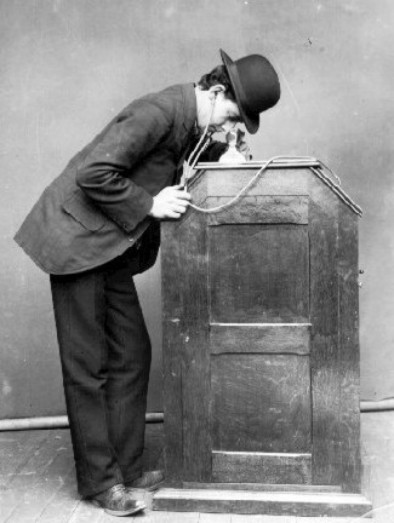 |
| A man viewing through a Kinescope |
By early 1895 during the French third republic and the reign of President Felix Faure, the brothers had invented their own device combining camera with printer and projector called Cinematographe. The was patented on february 13th 1895, it was much smaller than Edison's Kinetograph and was hand cranked.
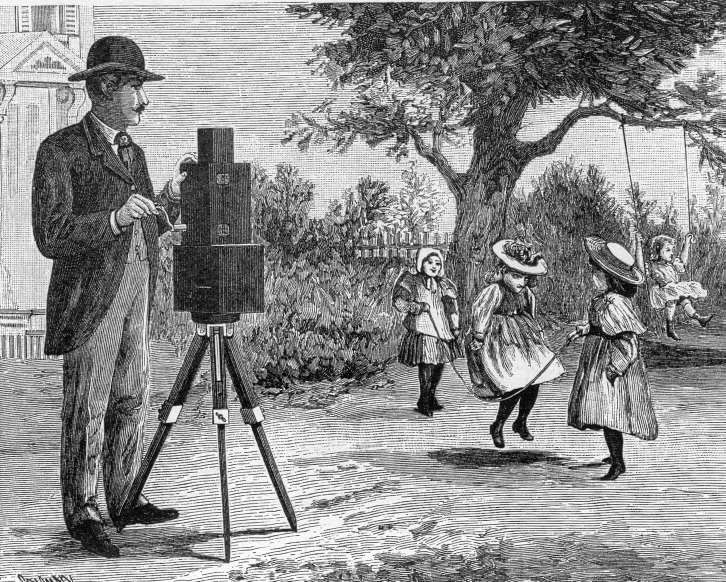 |
| A man cranking the cinematographe |
The lumieres used a film speed of 16 frame per seconds, much slower compare with Edison's 48 fps- this meant that less film was used and also clatter and grinding associated with Edison's device was reduced, each film is 17 meters long which hand cranked through a projector runs approximately 50 seconds. Louis's decision to incorporate the principle of intermittent movement using a device similar to that found in sewing machines, this was something Edison had rejected as he struggle to perfect projection using continuous movement. The brothers keeps their invention guarded secret with Auguste organising private screening.


The first screening was in paris on December 28 1895 at Salon Indien du Grand Cafe, a historical place and time of the first ever film screening in front of large audience with the Cinematographe that could project images to the wall. One the ten film showed was famous- sortie des usines lumiere a Lyon( workers leaving the Lumiere factory).
La Sortie de usines Lumière
LIST OF FILM IN EARLY DAYS OF CINEMATOGRAPH
La Sortie de usines Lumière (1894)
La Voltige (1895)
La Peche aux poissons rouges (1895)
La Debarquement du congres de photographie a Lyons (1895)
Les Forgerons (1895)
L’ Arroseur arrose (1895) Repas de bebe (1895)
Place des Cordeliers a Lyon (1895)
La Mer (1895)
La Peche aux poissons rouges (1895)
La Debarquement du congres de photographie a Lyons (1895)
Les Forgerons (1895)
L’ Arroseur arrose (1895) Repas de bebe (1895)
Place des Cordeliers a Lyon (1895)
La Mer (1895)
Louis photographed the world around him and some of his first
films were 'actuality' films, like the workers leaving the factory. The
brothers began to open theatres to show their films (which became known as
cinemas). In the first four months of 1896 they had opened Cinématographe
theatres in London, Brussels, Belgium and New York.
Their catalogues grew from 358 titles in 1897 to 1000 in 1898 to
2113 in 1903; although out of the 2113 titles in the 1903 catalogue, less than
50 were the brothers. The rest were taken by other operators like Promio,
Doublier and Mesguich. In 1900 the brothers projected a film on a huge 99 x 79
foot screen at the Paris Exposition, after which they decided to curtail their
film exhibitions and devote their time to the manufacture and sale of their
inventions.
In 1907 they produced the first practical colour photography
process, the Autochrome Plate.
Wednesday, 5 November 2014
CINEMATOGRAPHY
CAMERA MOVEMENT:
Crane shot from RENT
A crane shot is mostly used to indicate that a film has ended but it was used in this movie(RENT) during a concert. Crane shot gives the audience a wider view and panoramic effects.
Tracking shot is used to give the viewer a detailed tour, it's also used to follow a character. See an example below:-
Panning is used to give the viewer a panoramic view of a set/setting. Take a look at an example below:-
NARRATIVE THEORY ON ENDING SCENE OF RENT
Here, I am going to apply TZETAN TODOROV THEORY that suggest most narratives starts with state of equilibrium is which life is 'normal'. This state of normality is disrupted by an outside force,(an outside force is this particular is drug over-dose that almost claim the life of the characters) which has to be fought against in order to return to the state of equilibrium.
Tuesday, 14 October 2014
FILM MUSIC
GLOSSARY
SOUND is vibrations that travel through the air or another medium and can be heard when they reach a person's ear .In television and film production, sound is very important element of a good production. this sound has to be mixed very carefully to ensure that important sounds are emphasised and that the correct atmosphere for a sequence is maintained. some examples of sound elements is television and film is explain below:-

Diegetic sound:- Sound whose source is visible on the screen or whose source in implied to present by the action of the film, e.g
*Voices of characters
*Sound made by objects in the story
*Music represented as coming from instruments in the story space.
Non-diegetic sound:- Sound in film that you can only ear but the source is to visible. an example in below:-
Ambient:- Ambient music are genre of instrumental music that focuses on sound pattern more than melodic and its used to create certain atmosphere or state of mind. an example below
SFX:- This are artificially created or enhance sound. this is done by special software or instruments to emphasize artistic contents or other content in film and television.
Synchronous are those sounds which synchronized the picture. for example man playing saxophone and the action or movement sync with the picture.
Theme music:- This is the music that introduces, develops throughout and ends the film. it often indicates the 'personality' and mode of address of the movie. characters can have their own theme music-this is used to indicate their presence or 'emotional journey'.
Score music:- Used to create atmosphere, to link shots or sequences, to help create the narrative or to offer information about character. for example:-
Here are some list what music score does in film:-
1. Building sense of continuity
2. Creates more convincing atmosphere of space and time
3. Serve as background filler
4. pinpointing psychological refinement like unspoken word the character.
5. emphasize the theatrical build-up of a scene and rounding it off with a sense of finality.
Genre:- In film theory genre refer to the way the film are categorise based on the similarity elements the story is constructed on.
Types of genre in film and television:-
*Science fiction and fantasy
*Westerns
*Horror
*Musicals
*Documentary
*Romances
*Family
*Sports
*Biopics
*Music documentary
*Bollywood
*War films
*Drama
*Crime
*Documentary
*Action and adventure
*Animation
Mood:- Mood is emotional tone of the film, where a character show emotion like crying, angry, celebrating etc.
Tone:- Tone is how film make you feel and how it achieves that effect on yo. Camera work, lighting. editing, actor, music or sounds, colour scheme contribute to the tone of the film.
Voice-over:- Off-screen voice of a character that narrate or informs the external audience about the film. sometime it can be misleading but works effectively sometime on documentary.
Contrapuntal:- Contrapuntal sound occur when the visual and sound are in contrast with one another.
Silence:- very rarely complete silence in film and television to create an effect that will makes the audience react.
Selective sound:-
Sound bridges:- This is used in transitions between sequences.
SOUND OF SHELOCK HOLMES OPENING:-
- Theme music
- Sound from horse carriage
- Foot-steps of man running
- Guns corking
- sound from the horse bell
- Sound from the crow
- horse neighing
- Sound from burning fire
- Sound from broken classes
- Door opening
Theme music in this scene indicates suspense from the beginning with piano and pulse for few seconds using horse carriage sounds as the bridge sounds before the theme music started all over again with violin on low tempo then piano and the drums. the music started to build up with high tempo creating intense and action before the started fading into a lower tempo.
Sound from the horse carriage was used as a bridges but is also a diegetic sound because we can see the horse carriage and at the same time, we can hear the sounds.
Foot-steps from the man running is diegetic, because the audience can see the man running and at the same time hear his foot-steps.
Horses neighing,sound of the horse-shoe,quacking of the crow,sounds from burning fire,sounds from horse's bells,doors opening are all diegetic sound. The because the audience can relate both sounds with the pictures.
Sounds from broken glasses is non-diegetic because the audience can only hear it but can't see the picture of broken glasses.
Subscribe to:
Posts (Atom)